
Emergency Air Duct Cleaning Near Me: What San Clemente Homeowners Should Do First
If you’re searching for “emergency air duct cleaning near me” in San Clemente, the first thing to know is this: most duct emergencies are not about the cleaning itself. They’re about the sequence of decisions you make in the first hour after you discover the problem. Shut the system down too late, skip documentation, or hire the wrong crew, and you can turn a contained issue into a whole-house contamination event. Here’s exactly what to do, in order, before you call anyone.
We answer 24/7. If you’d rather talk through your situation before touching anything, call (866) 282-7304 and we’ll walk you through the first steps. Fast dispatch from 7am to 7pm, Sunday through Friday.
What Actually Counts as a Duct Emergency in San Clemente
Not every dirty duct is an emergency. Most systems that haven’t been cleaned in years are urgent in the sense that you should schedule service, but they don’t require immediate action. A genuine duct emergency falls into one of three categories, and each one has a different first response.
Post-flood intrusion. When water reaches your HVAC returns or supply registers, the ductwork becomes a humidity chamber. In San Clemente homes, this often happens after a slab leak, a water heater failure, or a storm-related intrusion. Water inside ducts doesn’t just sit there. It migrates, soaks into liner material, and creates conditions where microbial growth starts within days. If the system is still running, you’re distributing that moisture through every room.
Confirmed rodent or pest activity. This is the one that gets homeowners’ attention fast. Finding a dead animal in your ductwork, or clear evidence of nesting in attic duct runs, is not just a smell problem. Rodent droppings and dried urine become aerosolized when air moves across them. If you can smell it, you’re likely breathing particulates that originated in the nest.
Smoke or fire event. Wildfire smoke, a kitchen fire that reached the return air, or even prolonged candle soot can deposit fine particulates throughout the duct system. Smoke residue is acidic and oily. It bonds to duct surfaces and keeps off-gassing long after the visible event is over. In San Clemente, where wildfire smoke drifts in from inland events, this is a recurring seasonal concern.
If your situation is “the ducts have never been cleaned and the house is dusty,” that’s a real problem worth scheduling, but it’s not the kind of event this page is about. For routine air duct cleaning, you have time to compare providers and choose carefully. For the three scenarios above, the clock is running.
First Hour Protocol: Shut It Down or Leave It Running?
The single most consequential decision you’ll make is whether to turn the HVAC system off. It’s not always obvious, and the wrong choice can make things worse.
For water intrusion: shut it down immediately. Running air through wet ductwork spreads moisture and accelerates whatever biological activity is starting. Turn the system off at the thermostat, then switch the breaker for the air handler if you know which one it is. Leave it off until a professional assesses the extent of the water damage. Running the fan “to dry it out” is a myth in this context. Household HVAC airflow is not remediation-grade drying, and you’ll be distributing contamination while you try.
For rodent or pest contamination: shut it down, with one caveat. If you’ve found a dead animal in the system, stop the airflow. But if the dead animal is inside a duct run that serves a bedroom or nursery and the smell is already overwhelming, you have a short-term tradeoff. Some homeowners choose to run the fan on low with windows open for a few hours to make the space habitable while they arrange removal. This is a temporary measure, not a solution. The system should be off during and after the removal until cleaning and sanitizing are complete.
For smoke damage: leave it running, with filtration. This is the counterintuitive one. If San Clemente wildfire smoke has entered your home, the indoor air is often worse than outdoor air because smoke concentrates in enclosed spaces. In most cases, you want to run the HVAC fan continuously with the highest-MERV filter your system can handle, and keep windows closed. The ducted system becomes a whole-house air cleaner. If you have the option, run a standalone HEPA unit in the most-used rooms as well. Turn the system off only if you see soot deposits forming around supply registers, which signals heavy deposition in the ducts themselves.
Put a note on the thermostat with the date and time you shut the system down or changed the filter. That timestamp matters for documentation.
Documentation: What to Capture Before Anyone Arrives
Before you pick up the phone, spend ten minutes documenting. This is tedious, but it protects you in two ways: it gives any service provider accurate information, and it creates a record your insurer can actually use.
Take photos of everything. The visible water line. The dead animal or droppings. The soot around registers. The filter itself, both sides. Photos taken before anyone disturbs the scene are far more useful than anything taken after. If you have a moisture meter for gardening or woodworking, take readings at multiple vents and note them. If you don’t own one, skip it. Don’t guess.
Write down the sequence of events. When you first noticed the odor. When you shut the system down. Whether anyone in the house has respiratory symptoms. Whether the HVAC ran between the event and the discovery. This timeline helps a remediation-minded company understand what they’re walking into, and it helps an adjuster establish scope.
Pull your homeowners or rental insurance policy and read the water damage and mold sections. Coverage for duct contamination varies widely. Some policies cover duct cleaning after a covered water event. Others exclude it or cap it. Knowing what your policy says before you hire anyone changes how you approach the estimate. If you’re in San Clemente and dealing with a post-flood duct situation, check whether the event that caused the water is a covered peril. That’s the thing that usually determines whether duct remediation gets covered at all.
Finally, set expectations about cost. Cleaning after a contamination event costs more than routine cleaning because the scope is different. It involves containment, removal of contaminated material, sanitizing, and often repair. A written estimate is the only number that matters. Beware anyone who quotes a firm price over the phone without seeing the system.
How to Vet an “Emergency” Duct Cleaning Company in San Clemente
Fast response is valuable. Fast response without preparation is worthless. In a true contamination event, the company you hire needs to understand post-event remediation, not just duct brushing. There are specific questions that separate the two, and you should ask all of them before anyone puts a ladder in your hallway.
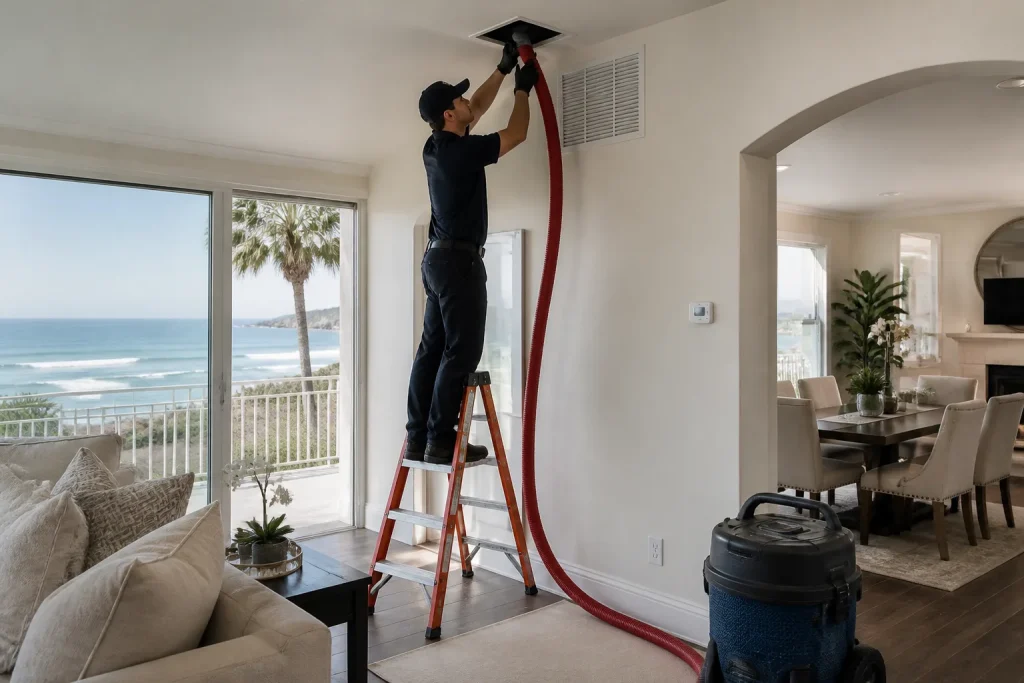
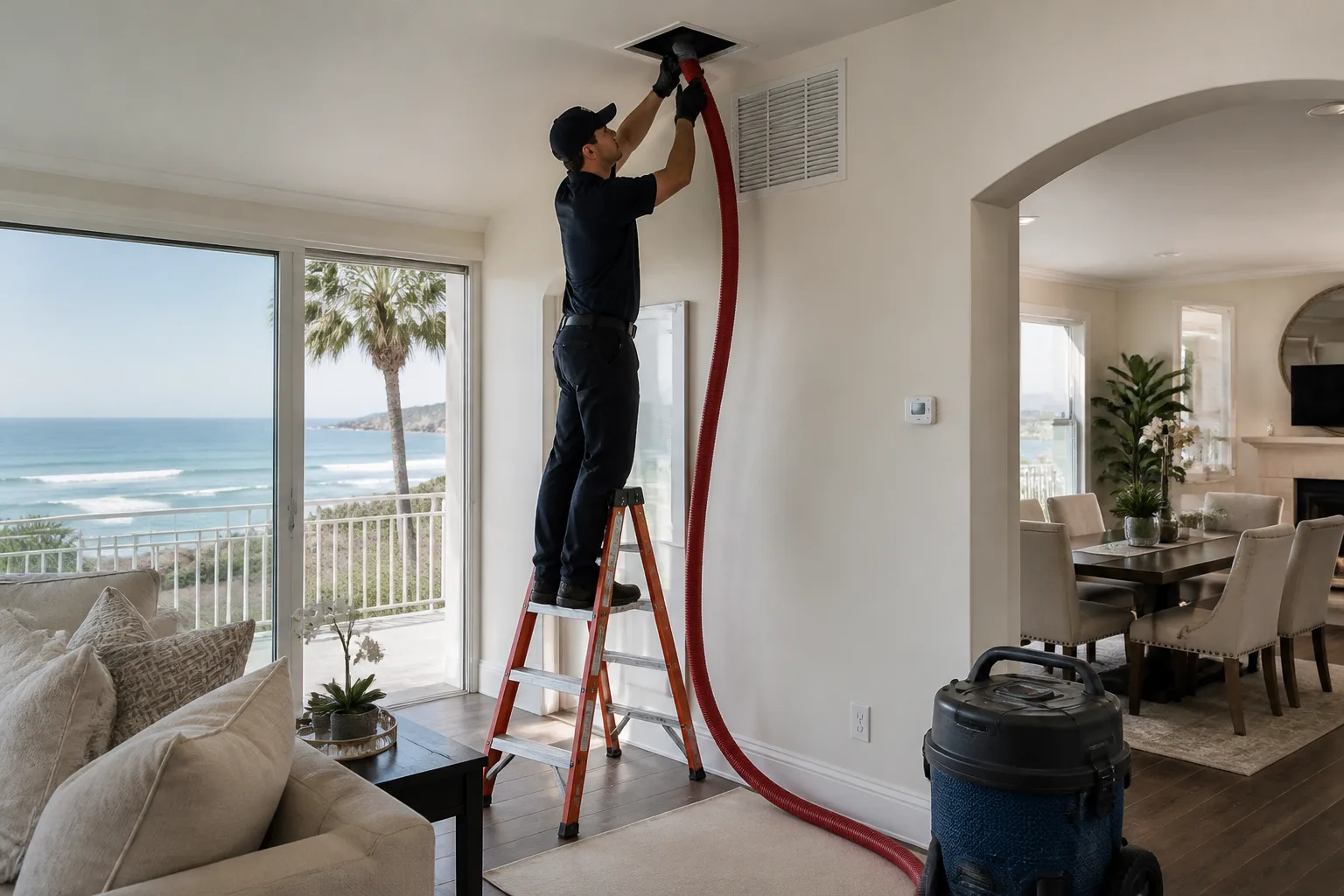
“What equipment do you use for contamination work?” This is the most telling question. A company that plans to run a consumer-grade vacuum through your ducts after a flood or rodent event doesn’t understand the job. Professional contamination work uses rotary-brush agitation paired with HEPA-rated negative-air collection. At Monarch Air Duct Cleaning, we run Rotobrush rotary-brush systems paired with Nikro HEPA-rated negative-air vacuums. The negative-air component matters: it keeps what we dislodge from escaping into your living space during the cleaning. We also run Abatement Technologies air filtration equipment during contamination jobs, which is the same category of equipment used in mold and asbestos remediation.
“Do you inspect before you quote?” If the answer is no, hang up. Post-event duct work requires seeing the actual contamination, understanding where the ducts run, and identifying whether any sections need replacement. A company that quotes sight unseen is guessing.
“Do you repair ducts, or just clean them?” Flood-damaged duct liner, rodent-chewed flex runs, and smoke-damaged insulation often need section replacement, not just cleaning. If your provider can’t handle dryer vent cleaning or duct repair in-house, you’ll be managing two contractors in the middle of an already stressful situation.
“How do you contain the work area?” The answer should include negative-air filtration and containment barriers during the job. If they look confused, they’re not the right crew.
We’ve walked into San Clemente homes after slab leaks where the homeowner had already scheduled a “deal” duct cleaning from a coupon mailer. The crew arrived, realized they were dealing with wet ducts, and left without doing anything except charging a trip fee. The estimate is free. The equipment either exists or it doesn’t. Ask first.
San Clemente-Specific Scenarios and What to Do in Each
San Clemente’s housing stock and local conditions create a few recurring emergency patterns. Here’s what to expect and where to start in each.
Slab Leak Reaching HVAC Returns
Slab leaks are common enough in Southern California that most longtime San Clemente homeowners know someone who’s dealt with one. When a slab leak forms near a return-air chase, water travels along the path of least resistance. Sometimes that path is into the ductwork. The first sign is often a musty smell that gets stronger when the system runs, or visible water staining around a floor-level return grate.
Your sequence: shut the system down, call a leak detection plumber if the water source isn’t already identified, document everything, then call us after the water source is stopped. We can’t clean ducts that are still being fed by an active leak. The cleaning happens after the water stops. In some cases, duct sections with saturated liner or insulation need replacement rather than cleaning. That’s a repair conversation, and it’s one we can have in the same visit.
Wildfire Smoke Event
When inland fires push smoke toward San Clemente, the fine particulate load in outdoor air spikes. Your HVAC system pulls that air into the ducts. Most of it gets caught by the filter, but a meaningful amount deposits on duct surfaces, especially in the return side where airflow slows at the filter transition. After a smoke event, you may notice a faint campfire smell when the system first kicks on, or brownish deposits on a new filter within a few weeks.
Your sequence: during the event, run the fan continuously with a fresh, high-MERV filter. After the event, replace the filter again and schedule a duct inspection. Smoke residue is not just cosmetic. It’s acidic and it accelerates degradation of some duct liner materials. Waiting months to address it makes the cleaning harder and may shorten the life of the liner.
Rodent Nesting in Attic Ductwork
Rodents love attics for the same reasons we would, if we were rodents: quiet, dark, and warm in winter. Attic duct runs made of insulated flex are particularly vulnerable. Rodents chew through the outer jacket and the inner liner, then nest in the insulation layer. The signs are usually smell, visible chew marks on flex runs, droppings in the attic, or a sudden loss of airflow to a room when a chewed section collapses.
Your sequence: shut the system down. Address the rodent problem itself before cleaning. No duct cleaning solves an active infestation. Once the pest issue is handled and entry points are sealed, the contaminated flex sections need replacement, not cleaning. Rodent urine and droppings inside a flex run are not a cleaning job. They’re a removal-and-replace job. If we find chew damage during an air duct cleaning visit in San Clemente, we’ll show you what we found and talk through replacement options before doing anything else.
When to Call a Pro
If you’ve made it this far and you’re reasonably sure you’re dealing with one of the three emergency categories, this is the point to stop researching and start making calls. Post-flood, post-pest, and post-smoke duct situations are not DIY territory. The equipment required is not available at a rental counter, and the health stakes are high enough that guesswork is a bad strategy.
If you’re in San Clemente and want a team that shows up with remediation-grade equipment, call (866) 282-7304. We answer 24/7. Fast dispatch from 7am to 7pm, Sunday through Friday. The estimate is free, the scope gets defined in writing before any work starts, and we’ll walk you through what we found with photos of your own system. Better air starts inside the walls.
The Bottom Line
Emergency duct situations demand a sequence, not just a service call. Shut the system down immediately for water and pest contamination. Leave it running with filtration for smoke. Document everything with photos and timestamps. Check your policy before you hire. And vet any “emergency” provider on equipment and process before you let them into the house.
The companies that respond fast and do it correctly are rare. The ones that respond fast and make things worse are common. Ask about negative-air equipment, ask about containment, ask whether they repair ducts in-house. If the answers are vague, keep looking.
If you’re in San Clemente and need help, Monarch Air Duct Cleaning offers free estimates. We clean it. We clear it. We fix it. Call (866) 282-7304. We answer 24/7. Fast dispatch from 7am to 7pm, Sunday through Friday. And if you found a dead animal in your ductwork, call us before you turn the fan back on. You’ll be glad you did.
Related services in San Clemente: dryer vent cleaning and full-system San Clemente air duct service, including repair of contaminated sections.
Frequently Asked Questions
How much does emergency air duct cleaning cost in San Clemente?
Cleaning after a contamination event costs more than routine cleaning because the scope includes containment, sanitizing, and often section replacement. A written estimate is the only number that matters, and any quote given over the phone before someone sees the system is a guess. Call (866) 282-7304 for a free estimate. We answer 24/7.
Should I turn off my HVAC if I smell a dead animal in the vents?
Yes, shut the system down. Running air across a dead animal or rodent nesting material aerosolizes particulates you don’t want to breathe. If the smell in a bedroom is overwhelming and you need temporary relief, you can run the fan on low with windows open for a few hours, but the system should be off during removal and until after cleaning and sanitizing. Call (866) 282-7304 and we’ll talk through your specific situation.
Can you clean ducts after a slab leak, or do they need to be replaced?
It depends on how much water reached the ducts and how long it sat. Some sections can be cleaned and dried after the water source is stopped. Others, especially flex runs with soaked insulation or visible liner damage, need replacement. The only way to know is to inspect. We clean it, and if it needs fixing, we handle that too. Call (866) 282-7304 for an estimate.
How do I know the emergency duct company I hire is qualified?
Ask what equipment they use. Contamination work requires rotary-brush agitation paired with HEPA-rated negative-air collection, plus containment during the job. We run Rotobrush systems paired with Nikro HEPA negative-air vacuums, and Abatement Technologies air filtration equipment on contamination jobs. If a company can’t name their equipment or doesn’t understand negative-air containment, they’re not prepared for post-event work. Call (866) 282-7304 with questions. We answer 24/7.
Written by the team at Monarch Air Duct Cleaning, serving San Clemente since 2012.
Need Air Duct Cleaning Help?
Call Monarch Air Duct Cleaning - licensed & insured, here with fast help in San Clemente.
(866) 282-7304